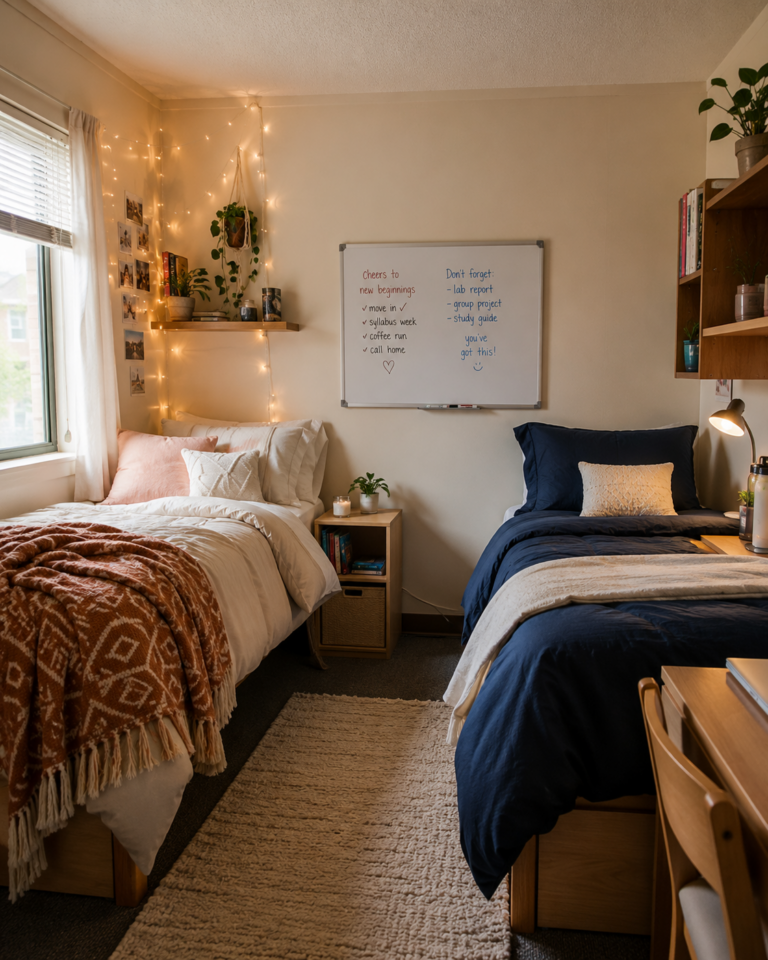
Random Roommate vs. Choosing One: Why Random Might Be the Better Move

Right now, somewhere in a Facebook group called something like “UMich Class of 2029 Roommate Finder,” a version of you is posting a selfie and a bullet list. Likes hiking. Early riser. Clean but not obsessive about it. Prefers quiet nights in but is down to go out sometimes. Looking for someone chill.
Everyone in that group is posting the same list. And everyone is DM-ing the people whose lists most closely resemble their own.
It feels productive. It feels like taking control of something that is otherwise out of your hands. But there is a reasonable argument, backed by how this actually plays out, that hitting “random assign” on your housing form is the smarter move. Here’s why.
What the Facebook Group Actually Selects For
When you pick a roommate from a Facebook group, you’re selecting for surface-level compatibility with a stranger you’ve known for forty-eight hours of text messages. You’re looking at Instagram grids and making calls based on whether her aesthetic matches yours. You’re DM-ing the girl who also loves Taylor Swift and has a similar sleep schedule according to her post, and you’re feeling good about it.
What you’ve actually selected for: someone who presents the same way you do online. That’s not the same as someone who’s easy to live with.
The things that actually make a roommate relationship work, or not work, don’t show up in a Facebook bio. They show up in how someone handles it when you ask them to turn down their music at midnight. Whether they clean up after themselves without being asked. How they behave when they’re stressed, or sad, or having a bad week. None of that is visible on an Instagram profile, and none of it comes up in the polite DM conversation you’re going to have before move-in.
What Random Actually Gives You
A randomly assigned roommate is someone the school picked based on a housing questionnaire: sleep schedule, cleanliness preferences, study habits. It’s not a vibe match. It is, at minimum, a functional-compatibility baseline.
More importantly, it’s someone outside your existing world. When you arrive at college, you’re going to meet a lot of people quickly and form your friend group largely from whoever is physically closest to you in the first two weeks. If your roommate is someone you pre-selected from your own social media sphere, someone who already knows some of the same people you know, you’ve narrowed that radius before you’ve even arrived.
A random roommate is a guaranteed introduction to someone you would not have found yourself. That is not a liability. That is the entire point of college.
Duke University switched to mandatory random roommate assignment for freshmen and found something counterintuitive: no increase in reassignment requests, and no meaningful uptick in complaints. Students adapted. Most of them were fine. Some of them became close. A few didn’t, and they figured that out too.
The Trap Nobody Talks About
When you choose a roommate in advance, you’ve created a social obligation before you’ve moved in. You’re now responsible for each other’s feelings in a way that a stranger isn’t. If the chosen roommate turns out to be a bad fit, the conversation you have to have is harder, because you chose this. You vouched for it. There’s history, even if it’s only two months old.
A random roommate comes with no prior expectations on either side. If it goes well, it’s a genuine surprise. If it doesn’t, the path to a room change or a frank conversation is cleaner, because neither of you made a promise.
The Things That Actually Matter Before Move-In
If you do go random, there’s one conversation worth having before you show up on move-in day: the practical one. Not “what’s your vibe” but the actual logistics.
What time do you go to sleep and wake up? How do you feel about guests in the room, and how much notice do you need? What’s your definition of clean? Are you okay with the overhead light or do you need it off to sleep? These are the questions that determine whether you’re going to have a problem. Ask them directly, before you arrive, and you’ve handled most of what causes roommate friction in the first semester.
Everything else, you figure out as you go. That’s true whether you chose each other or not.
The Bottom Line
The Facebook group is not a bad instinct. It comes from a real place: wanting some control over what feels like a completely unknown situation. But the control it offers is mostly illusory. You cannot vet a stranger into someone who’s easy to live with. You can only find out, by living with them.
Random assignment skips the audition process and puts you directly in the room with someone new. The research suggests that outcome is roughly equivalent to the chosen version, and occasionally better.
Trust the process, have the practical conversation before move-in, and let freshman year be more unpredictable than you planned. That’s usually where the good parts are.