The Generation That Has to Figure Out College and AI at the Same Time
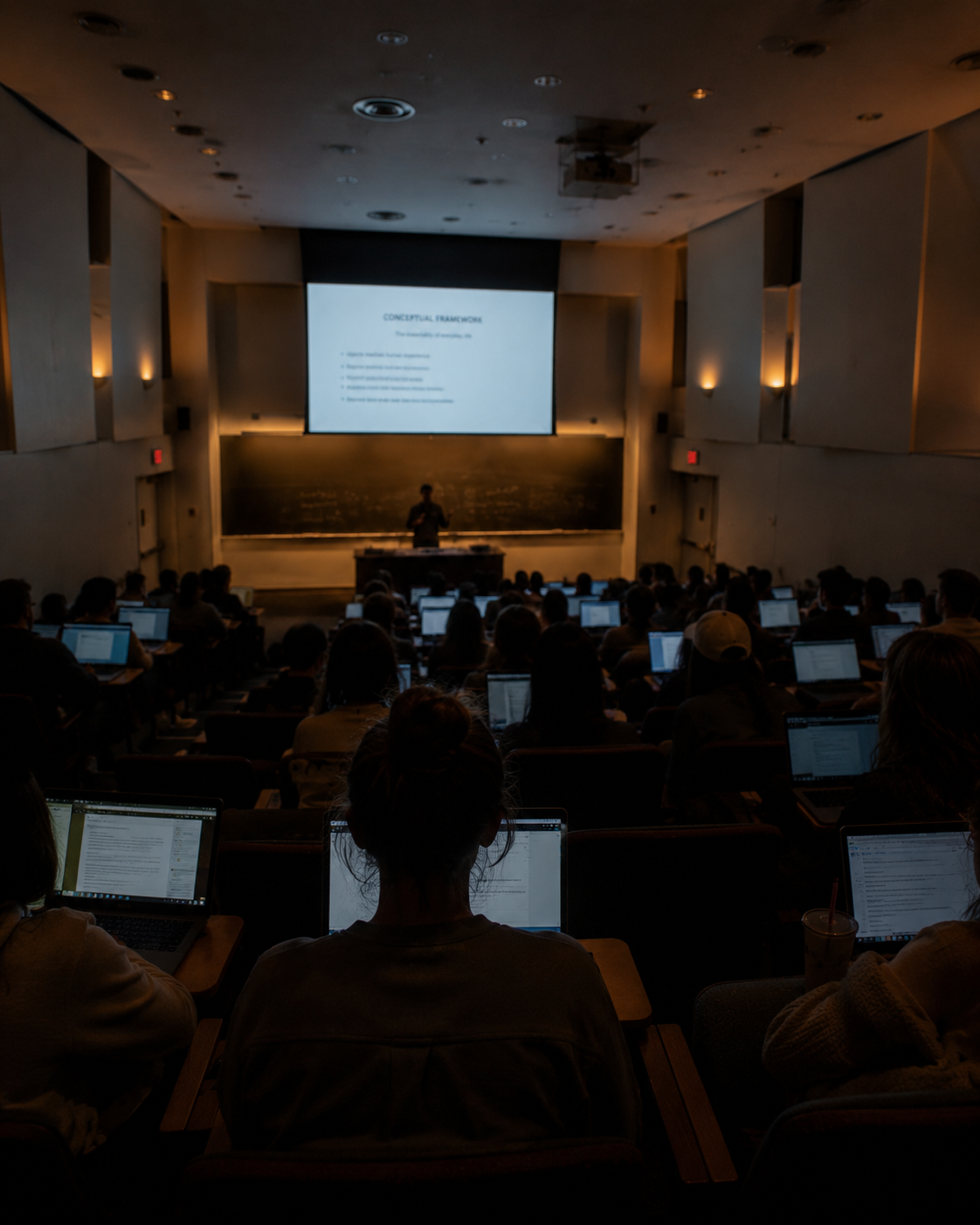
Every syllabus has a different policy now. One professor bans AI entirely and will run your work through a detection tool you’ve never heard of. The next professor requires you to disclose any AI assistance, with no definition of what counts as assistance. The one after that has said nothing about it at all, which creates its own kind of anxiety. By week two, you’ve stopped assuming you know the rules and started reading every syllabus like a contract.
This is what college looks like in 2026. Not as a hypothetical. As the actual texture of the week.
Lumina-Gallup data from this year found that 47% of current college students are considering changing their major because of AI, and 13% already have. Gallup separately found that Gen Z excitement about AI dropped 14% in a single year, falling fastest among the people who use it most. That’s not the data point of a generation that found peace with the technology. It’s the data point of a generation that got close enough to understand what they were actually dealing with.
The Classroom Nobody Designed for This
The policy incoherence is real. A Stanford Daily investigation from March 2026 found that AI policies now vary not just between universities but between professors in the same department teaching the same course. One professor’s academic integrity violation is another’s encouraged workflow tool. Students navigate this by checking every syllabus individually and, when in doubt, asking, which itself has become a kind of social calculus: do you ask and signal that you were considering using it, or do you not ask and guess?
The College Board found this year that 92% of faculty are concerned about AI undermining students’ original writing and critical thinking. Most of those same faculty are simultaneously unsure how to structure assignments that can’t be AI-generated, because the list of those assignments is shrinking in ways that aren’t obvious until you try to write one. The professors are figuring this out alongside the students, which is either comforting or alarming depending on your temperament.
What Everyone Is Doing and Nobody Is Saying
Here’s what is actually true, which anyone who has been in a college class in the last two years already knows: almost everyone is using AI for something. The question is not whether but how much and for what, and the honest answer to that question depends heavily on who’s asking.
The Axios reporting from April captures something real: Gen Z is terrified of the AI revolution and nobody is preparing them for it. The fear is not that they’ll get caught using it. The fear runs deeper: the skills they’re building, the ones the major was designed to teach, might not be the skills that matter by the time they graduate.
That fear is worth taking seriously rather than dismissing. The student who switched from business analytics to marketing because AI was automating her statistical coursework made a rational calculation. The question is whether the calculation is actually right, or whether it’s the anxious version of right, the kind that mistakes “this technology can do a version of this task” for “this task no longer has human value.”
What Four Years Is Actually For
This is the place where the conversation usually either tips into panic or reflexive reassurance, and neither is particularly useful. So here’s what the data actually says.
Inside Higher Ed (May 2026) found that even as AI use spreads, more than three-quarters of bachelor’s degree holders call their degree critical or important to reaching their career goals. College graduates still earn a median of around $80,000 a year compared to $47,000 for high school graduates, a gap that has not narrowed in the AI era. The credential still functions. The network still functions. The four years still builds something that doesn’t appear on a transcript.
What those four years build is harder to name than a GPA. It’s the capacity to sit with a hard problem for longer than feels comfortable. It’s the experience of being wrong in front of people and recovering. It’s the relationships with professors who push back on your thinking, with peers who come from different places and have different assumptions, with the version of yourself that has to make decisions without a parent in the room. AI can generate the essay. It cannot be in the room.
The anxiety about majors and AI-proof careers is understandable, and some of it is warranted. Fields are changing. Some specific skills are being automated. The students who come out of this moment well won’t be the ones who picked the most defensive major, though. They’ll be the ones who understood that what college builds at its best is judgment, and that judgment is still the thing you’re here to develop.
The Part That’s Actually New
What’s genuinely novel about this moment is not that the economy is changing (it always is) but that the change is visible in real time in a way it rarely has been before. Previous generations couldn’t watch their skills become automated while they were still in the process of acquiring them. This generation can, and that visibility creates a kind of ambient anxiety that is difficult to metabolize because it never fully resolves.
There is no version of choosing a major right now that comes with certainty. There is no field that is clearly safe. The students who are navigating this most coherently seem to be the ones who have separated two questions that tend to get collapsed: what do I want to spend four years learning, and what will the job market look like when I graduate? Those are related questions, but they’re not the same question, and treating them as identical produces the kind of paralysis that is more damaging to the four years than any specific major choice.
The rules in every classroom are different. Nobody has the canonical answer to what counts as your own work anymore. The degree is still worth getting and the calculation of why is less obvious than it used to be. All of that is true at once, which is uncomfortable, and also just the situation you’re in.
The generation that has to figure this out doesn’t get a clean version. It gets the version where you read the syllabus carefully, make reasonable judgments about what you’re actually trying to learn, and build the things that can’t be generated. That’s not less than what previous generations got. It might be more demanding. It’s definitely real.